Skip to product information
1 of 5
CLUSTER DEXTRIN®

Next-gen endurance gel

4.8 Rating 87 reviews on Trustpilot
Stomach friendly
High water content
Not too sweet
No aftertaste
No caffeine

Built to fuel your training without compromising your long-term health. Made with Cluster Dextrin®, not maltodextrin (which four studies link to gut-barrier concerns), dosed in 30g and 40g sachets you mix to any target up to 120 g/hr. Informed Sport certified.

1
Choose size
2
Select quantities
30g per gel
4.8 ★ from 87 reviews · 60-day money back
View full details

THE GOLD-STANDARD CARB

Cluster Dextrin®, not maltodextrin. Lower osmolality so it sits easier and unlike the maltodextrin in most gels it’s built to protect your gut health over years of sessions.

See the science

OLYMPIC DESIGNED

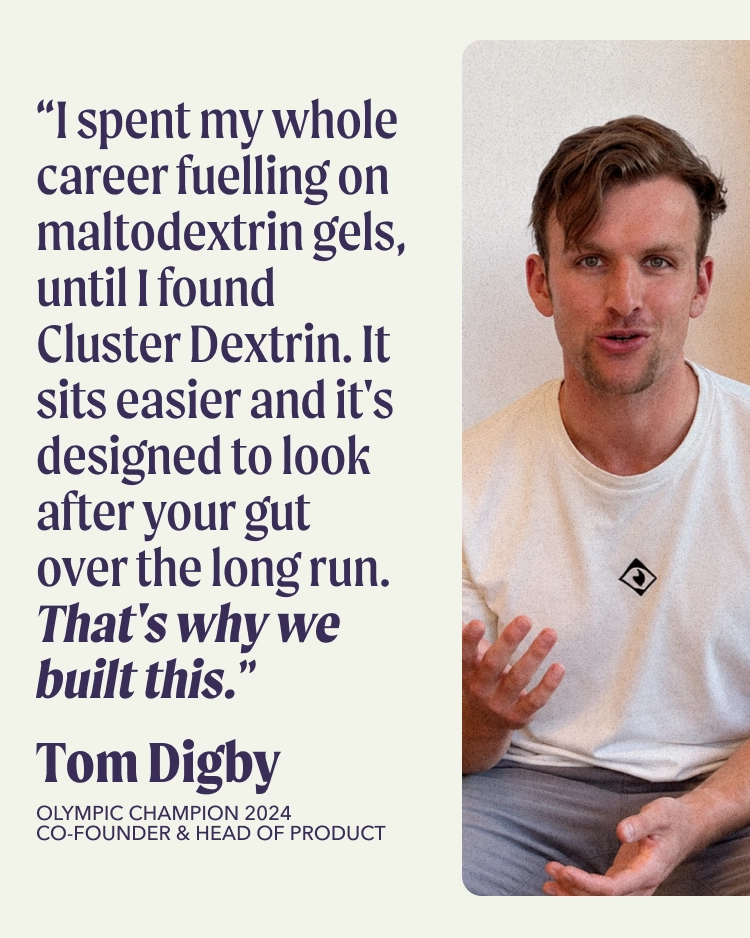
Built by Olympic Champion Tom Digby, who came off maltodextrin himself over gut-health concerns, alongside sports scientists and real athlete analysis.

Watch Tom's story

INFORMED SPORT CERTIFIED

The only Informed Sport Cluster Dextrin® gel on the market. Tested for banned substances, trusted by tested athletes.

CLUSTER DEXTRIN®

This is not just another gel.

Most gels run on maltodextrin. We run on Cluster Dextrin®, the gold-standard carb that performs better, sits easier, and is made for athletes thinking about more than today's session.

WHAT THE KAIJU CARB GEL DOES FOR YOU

Built on three things that
matter to your body.

01

GUT HEALTH

Most other gels run on maltodextrin. Four studies show why we don't.

Walk down any sports-nutrition aisle and maltodextrin is in most gels you'll find. Four peer-reviewed studies raise questions about its effect on gut barrier function and antimicrobial defence. Cluster Dextrin® has no equivalent concerns documented and behaves structurally like a fibre through parts of the gut.

02

PERFORMANCE

Same effort, felt easier, and you go longer.

In head-to-head cycling research at matched carb load, athletes reported lower perceived exertion on Cluster Dextrin® than on maltodextrin and rode for longer before failure. Same workload, more left in the tank.

03

GUT COMFORT

30× lower osmolality. GI distress on par with drinking water.

Maltodextrin pulls water into your gut — that's the source of mid-effort sloshing and nausea. Cluster Dextrin® has 30× lower osmolality and empties the stomach 33% faster than glucose. In cycling research, GI distress on Cluster Dextrin® is statistically indistinguishable from drinking plain water.

COMMON GEL PROBLEMS

You've tried
the others.
Sound familiar?

Questioning the long terms effects of taking carb gels

Bloated, sloshing stomach mid-effort

Sticky in the mouth, reaching for water to wash it down

Nausea once the pace picks up

“Mouthfeel, gut comfort,
performance, and your
long-term health.
That’s what we prioritise.”

TOM DIGBY OLY

Head of Product

HOW WE COMPARE

A side by side look at
why our formula performs
differently.

OTHERS
KAIJU
CARB SOURCE

Maltodextrin or glucose

Cluster Dextrin® + fructose (2:1)

GUT HEALTH
STUDIES

4 raise concerns (maltodextrin)³

None documented

OSMOLALITY
(10%)

~269 to 646 mOsm

~8 mOsm (30x lower)¹

Draws less water into the gut — less risk of sloshing.

GASTRIC
EMPTYING

~39.9 min (glucose)

Cluster Dextrin® + fructose (2:1)

Moves out of your stomach faster — less nausea, less risk of stomach issues.

CARB DENSITY

20 to 25 g per sachet

30 g or 40 g per sachet (mix to hit any target up to 120 g/hr)

GI DISTRESS
(CYCLING)

~2× vs water

Same as water²

PERCEIVED
EXERTION

Baseline (maltodextrin)

Lower RPE at matched carb load⁴

TIME TO
EXHAUSTION

Baseline (maltodextrin)

Longer before failure⁵

CERTIFICATION

Varies

Informed Sport certified

  1. Takii, H. et al. (2005). Effect of Highly Branched Cyclic Dextrin solution on osmolality and post-exercise plasma glucose. J. Nutr. Sci. Vitaminol.
  2. Takii, H. et al. (2004). HBCD increases endurance in cycling and lowers GI distress to water-equivalent levels. Food Sci. Technol. Res.
  3. Nickerson, K.P. & McDonald, C. (2015). Maltodextrin compromises intestinal antimicrobial defence. PLoS ONE.
  4. Furuyashiki, T. et al. (2014). HBCD vs maltodextrin in trained athletes: lower RPE during sustained exercise. Biosci. Biotechnol. Biochem.
  5. Shiraki, T. et al. (2015). HBCD ingestion improves time to exhaustion in endurance athletes vs maltodextrin. J. Phys. Fitness Sports Med.

SCIENCE, EXPERIENCE, RESULTS.

The team behind
performance and long
term health

Helene Defrance

SPORT SCIENTIST

Olympic medalist. Bridges research and practice.

Gareth Nicholas

PERFORMANCE
NUTRITIONIST

Shapes Kaiju's formulations with evidence-based expertise.

Real Athletes. Real results.

What endurance
athletes say

4.8 ★ from 87 reviews on Trustpilot

FAQ

Myth: Cluster Dextrin is slow digesting, so it’s not suited to maximal efforts?

The case put against Cluster Dextrin® is that maximal efforts need rapid carbohydrate breakdown. But this confuses two completely different stages. The stomach is not where energy is absorbed, the small intestine is. The stomach's only job is to empty its contents into the small intestine, where carbohydrates are broken down and absorbed into the bloodstream. Gastric emptying rate is therefore the critical variable, not how quickly something is digested in the stomach. Cluster Dextrin's near zero osmolality (~9 mOsm) means the stomach detects almost no osmotic load and empties rapidly. In a study measuring gastric emptying using real time ultrasound, Cluster Dextrin cleared the stomach in 26.7 minutes vs 39.9 minutes for glucose, 33% faster (Takii et al., 2005). Critically, when Cluster Dextrin was combined with electrolyte minerals, exactly as our Gel, it emptied faster still, significantly faster than any standard dextrin based sports drink tested (Takii et al., 2005). With the minerals in our Gel, Cluster Dextrin reaches the small intestine faster than anything else tested. Once there, it is hydrolysed and absorbed as glucose via SGLT1, the identical mechanism to every other carbohydrate.


Studies referenced
Takii et al. (2005), International Journal of Sports Medicinehttps://pubmed.ncbi.nlm.nih.gov/15900642/

I find it hard to fuel while running or cycling all out, why is Cluster Dextrin different

Intense exercise suppresses gut motility and reduces GI tolerance, your gut is already under stress before you add a gel. Introducing a high osmolality carbohydrate at that moment is precisely when maltodextrin and glucose cause problems. In a head to head cycling study, the standard dextrin group reported approximately twice the rate of GI disorders, bloating, belching, nausea, compared to the Cluster Dextrin® group, whose symptoms were statistically indistinguishable from water (Takii et al., 2004). A separate systematic review confirmed that GI distress during exercise is mechanistically driven by osmolality and carbohydrate type, both of which Cluster Dextrin addresses (de Oliveira and Burini, 2014). Cluster Dextrin's 30x lower osmolality means it does not draw water into your gut, does not sit in your stomach, and does not compete with your muscles for blood flow.


Studies referenced
Takii et al. (2004), Food Science and Technology Researchhttps://www.jstage.jst.go.jp/article/fstr/10/4/10_4_428/_article
de Oliveira & Burini (2014), Nutrients (PMC)https://pmc.ncbi.nlm.nih.gov/articles/PMC4210913/
Jeukendrup & Moseley (2010), Scandinavian Journal of Medicine and Science in Sportshttps://pmc.ncbi.nlm.nih.gov/articles/PMC5371619/

Isn’t Cluster Dextrin is absorbed more slowly than maltodextrin, I need energy now!

Cluster Dextrin® passes through the stomach 33% faster than glucose because of its near zero osmolality (Takii et al., 2005). It arrives at the small intestine earlier than maltodextrin or glucose would. Once there, it is hydrolysed and absorbed as glucose via SGLT1, the identical mechanism to every other carbohydrate. When combined with electrolyte minerals, gastric emptying accelerates even further (Takii et al., 2005). The fructose in our Gel is absorbed simultaneously via GLUT5, a completely separate transporter that runs in parallel, not in competition (Jeukendrup and Moseley, 2010). The result is earlier arrival at the intestine, dual pathway absorption, and fuel in the bloodstream faster than any single source maltodextrin or glucose product.


Studies referenced
Takii et al. (2005), International Journal of Sports Medicinehttps://pubmed.ncbi.nlm.nih.gov/15900642/
Jeukendrup & Moseley (2010), Scandinavian Journal of Medicine and Science in Sportshttps://pmc.ncbi.nlm.nih.gov/articles/PMC5371619/

Why not just a product with Hydrogel?

Hydrogel does not actually change the osmotic load, it just smooths it out, so that same load is delivered over a longer period rather than hitting the gut all at once. Choosing a lower-osmolarity carbohydrate circumvents it entirely. Glucose has an osmolality of ~646 mOsm at 10% concentration. Maltodextrin sits at ~269 mOsm. Cluster Dextrin® sits at ~9 mOsm, roughly 30x lower than maltodextrin and 72x lower than glucose, it is gut comfortable by molecular design, without any engineering required (Takii et al., 2005). Hydrogel exists because maltodextrin and glucose needed it.


Studies referenced
Takii et al. (2005), International Journal of Sports Medicinehttps://pubmed.ncbi.nlm.nih.gov/15900642/

Why are they more expensive than other gels?

One reason. Cluster Dextrin® costs roughly seven times more than maltodextrin per kilogram. Every other ingredient in a standard sports gel, maltodextrin, water, flavouring, a bit of sodium, is relatively cheap. Cluster Dextrin is not. That cost difference flows directly into the price of the finished product.

Why does Cluster Dextrin make the same effort feel easier vs Maltodextrin?

In a double-blind study, cyclists doing the same workout at the same calories reported significantly lower perceived exertion on Cluster Dextrin® than on maltodextrin (Furuyashiki et al., 2014). The mechanism is suspected to be these three things at once:
RPE is not a pure measure of muscle fatigue, the brain integrates everything, including gut discomfort. On maltodextrin, the osmotic load and delayed gastric emptying register as a component of effort. Cluster Dextrin's near-zero GI symptoms remove that signal entirely.
At the same time, Cluster Dextrin clears the stomach 33% faster than glucose, so fuel reaches the bloodstream sooner and produces a more sustained glucose curve rather than a spike and crash (Takii et al., 2005).
Finally, a study in triathletes found lower cortisol and inflammatory markers on Cluster Dextrin versus glucose at the same workload, which under the central governor model means the brain interprets the session as less costly and permits lower perceived effort without any reduction in output (Suzuki et al., 2014). So the same workload feels easier.


Studies referenced
Furuyashiki et al. (2014), Bioscience, Biotechnology and Biochemistryhttps://www.tandfonline.com/doi/full/10.1080/09168451.2014.943654
Takii et al. (2005), International Journal of Sports Medicinehttps://pubmed.ncbi.nlm.nih.gov/15900642/
Suzuki et al. (2014), triathlete study (referenced in NutraBio review) — https://nutrabio.com/blogs/endurelite/king-of-carbs

Why not just have maltodextrin, because it's cheaper, and then eat fermented foods Kombucha, kimchi, kefir, etc?

If maltodextrin really is tougher on your gut than gentler carbs — as a growing body of research suggests — then leaning on fermented foods to offset it means their benefit is partly spent before it even starts. Because Cluster Dextrin® appears to be far kinder to the gut, that benefit goes further. So the live cultures in your kombucha, kimchi and kefir can get on with what they do best, feeding good bacteria, building microbial diversity and supporting digestion, leaving your gut better off overall.


Studies referenced (the maltodextrin gut-health research behind "a growing body of research")
Nickerson et al. (2015), PLoS ONEhttps://pmc.ncbi.nlm.nih.gov/articles/PMC4615306/
Wlodarska et al. (2014), PLoS ONEhttps://pmc.ncbi.nlm.nih.gov/articles/PMC4084946/
Laudisi et al. (2018), Cellular and Molecular Gastroenterology and Hepatologyhttps://pmc.ncbi.nlm.nih.gov/articles/PMC6369223/
Maltodextrin and colitis (2022), Frontiers in Immunologyhttps://pmc.ncbi.nlm.nih.gov/articles/PMC8963984/
Maltodextrin as placebo, systematic review (2022), European Journal of Nutritionhttps://pmc.ncbi.nlm.nih.gov/articles/PMC9835112/

What is the difference between HBCD and Cluster Dextrin?

"HBCD" and "Cluster Dextrin" get used interchangeably, but they are not quite the same thing. HBCD (highly branched cyclic dextrin) is the generic ingredient category. Cluster Dextrin® is the branded, premium-grade HBCD, and the difference shows up in four places.


Purity: generic HBCD can run as low as around 80% pure, the rest made up of shorter, more maltodextrin-like fractions that carry the higher osmolality and gut load we are trying to avoid and impurities. Cluster Dextrin is produced to around 98% purity, so far more of what you take is the true high-molecular-weight, low-osmolality branched structure.


Taste: Cheaper generic HBCD tends to carry more off-notesfrom those lower-grade fractions and impurities.


Quality standards: Cluster Dextrin is manufactured to consistent food and pharma-grade specifications with reliable batch-to-batch consistency.


The evidence base: critically, the studies behind the performance and gut-comfort claims, the 33% faster gastric emptying, the lower RPE, the GI distress indistinguishable from water, were run on Cluster Dextrin.


Studies referenced
Takii et al. (2004), Food Science and Technology Researchhttps://www.jstage.jst.go.jp/article/fstr/10/4/10_4_428/_article
Takii et al. (2005), International Journal of Sports Medicinehttps://pubmed.ncbi.nlm.nih.gov/15900642/
Furuyashiki et al. (2014), Bioscience, Biotechnology and Biochemistryhttps://www.tandfonline.com/doi/full/10.1080/09168451.2014.943654
Shiraki et al. (2015), Japanese Journal of Physical Fitness and Sports Medicinehttps://journalofexerciseandnutrition.com/index.php/JEN/article/download/100/89/104
Suzuki et al. (2014), triathlete study (referenced in NutraBio review) — https://nutrabio.com/blogs/endurelite/king-of-carbs